Networking
March 26, 2026
How to Network at Events (Without Feeling Awkward or Salesy)
Networking at events made simple: sharp networking tips, conversation starters, lead capture lines, and follow-up you can actually send.
Networking events, marketing events, and conferences all get treated the same way: show up, meet a bunch of people, collect business cards, and call it a win. Most people do it that way because it sounds measurable.
It is measurable. Just not useful.
Networking at events is rarely about meeting many people. It’s about positioning: where you stand in someone’s mind after a short moment—before they have time to forget you.
The twist: the “awkward” feeling usually comes from trying to skip the small moment and jump straight to the pitch. Don’t do that. Build tiny moments instead: one observation, one question, one helpful next step.
If you’ve been searching for how to network at conferences or business networking tips, here’s the insider shift: treat networking at events like leaving clean breadcrumbs, not starting sales conversations.

Like a trail of breadcrumbs: each small moment helps someone remember who you are and why they should talk to you again.
That’s how you get better networking conversation starters without sounding like you’re asking for something.
Quick mindset shift
- You’re not interviewing.
- You’re not performing.
- You’re leaving a clean signal in someone’s head.
If you want a structured way to turn a conversation into a demo-ready story, use our demo flow example.
Why Most People Fail at Networking Events
Here’s what most people do wrong at networking events—and why it backfires:
- Arrive too early. The first 30 minutes are awkward for everyone. You talk because you’re nervous, not because there’s a real opening. Wait until the room is warm.
- Float without anchoring. They hop from person to person every couple of minutes. People don’t remember that. They remember the person who stayed long enough to ask a real question.
- Sound impressive instead of interested. They lead with titles, numbers, or “what they do.” That creates distance. It turns you into a stranger with a resume.
- Treat merch and follow-up like an afterthought. They ask for a card, then vanish. Or they grab swag and never talk again. Both feel transactional.
- Try to network like a funnel. “So… are you interested?” is the fastest way to kill curiosity.
Insider take: if you want networking conversation starters that don’t feel cringe, stop hunting for “the line.” Use the event itself as the cue.
7 Networking Tips That Actually Work at Events
These are networking event tips you can use in real life: short, event-shaped, and easy to repeat when you’re moving between sessions.
Arrive at the Right Time (Not Too Early)
Don’t show up at the start. Show up when conversations are already flowing.
Use this timing rule:
- Talk to people 15–30 minutes after the first session starts.
- Avoid the final 10 minutes. Everyone is packing and rushing.
One line that buys you entry without sounding needy:
- “Is this your first time at this event?”
It’s simple, it’s neutral, and it doesn’t require you to be interesting.
Focus on One Conversation at a Time
Most networking tips tell you to “meet more people.” That’s marketing advice dressed up as strategy.
Try this instead:
- Pick one conversation you can deepen for 5–10 minutes.
- Leave when the topic is still warm—not when it’s empty.
Quality beats quantity because the best outcomes come from memory, not contact.
Don’t Lead with What You Do
Titles feel like a sales move. Especially at marketing events where everyone is ready to sell something.
Replace “What do you do?” with an easier entry:
- “What brought you here this year?”
- “What problem are you trying to solve in the next quarter?”
- “What session actually changed your thinking?”
Once they answer, you can mirror with precision:
- “That makes sense. The teams I talk to usually get stuck on [X]. Are you seeing that too?”
Now you’re helping, not pitching.
Keep Conversations Easy, Not Impressive
You don’t need to impress them. You need to create comfort.
Easy conversation patterns:
- Small agreement: “Yeah, that’s a real pain.”
- Specific follow-up: “When it happens, is it usually [time/budget/process]?”
- Gentle contrast: “Interesting—most people tell me the opposite.”
Avoid “impressive” language like: transformation, disruption, exponential, best-in-class.
Instead, use concrete phrases:
- “What’s the current workflow?”
- “Where does it break?”
- “What do you want to be true instead?”
Have a Simple One-Line Introduction
You will need to introduce yourself. Do it like a label on a bottle—short and clear.
Use one of these:
- “I work on sales software teams. My job is helping explain the product clearly.”
- “I work with SaaS sales teams so buyers understand what they should do next.”
- “I’m focused on how presenters turn product moments into outcomes.”
Then stop. Let them talk.
If you’re presenting a technical product, you can borrow the same pattern: name the “before,” name the “shift,” then stop. (If you want an example talk track, use Talk Track Builder.)
Exit Conversations Gracefully
The fastest way to feel salesy is to linger past the point where the other person wants you to go.
Use a clean exit line:
- “This was helpful—mind if we swap contacts so I can send that idea?”
Or even softer:
- “I’ll let you get back to the room. Before you go—what’s the one thing you’d tell someone new to this topic?”
Exit while the conversation still has energy. People will remember you more fondly.
Focus on Quality Over Quantity
Here’s a contrarian truth: networking at events often fails because it’s treated like a task list.
Change the goal:
- Don’t track “how many.”
- Track “how many people I left in a better spot than I found.”
That means you:
- asked one sharp question,
- offered one small resource (even mental ones),
- created one clear next step.
That’s what turns a hallway chat into a lead.
Real Example of a Great Networking Conversation
Scene: you’re standing near the coffee line at a conference. You see someone holding a notepad, looking slightly stressed.
Most demo mistakes are predictable. Run the checklist before your next customer call.
Generate my checklistYour opener:
- “What are you hoping to figure out at this event?”
Them:
- “We’re trying to improve how our demos convert—right now, buyers don’t get why our product matters.”
Your response (curiosity first):
- “That’s a common gap. When it falls flat, is it usually too technical, or too fast?”
Them:
- “Too fast. We show things before they understand the problem.”
Your gentle pivot (positioning, not pitching):
- “So you’re getting the ‘impressed but unconvinced’ effect.”
Then a helpful next step:
- “If you want, I can send a simple before-and-after story you can test—no prep required.”
Key differences from a typical “salesy” exchange:
- You didn’t ask, “Can I book a call?”
- You didn’t lead with features.
- You reflected the problem back in plain language.
They wanted help. You made it easy to accept.
How to Handle Event Merch (Without Being Awkward)
Merch is a conversation accelerant. It’s also a social trap.
There are two cases: asking for merch, or giving it.
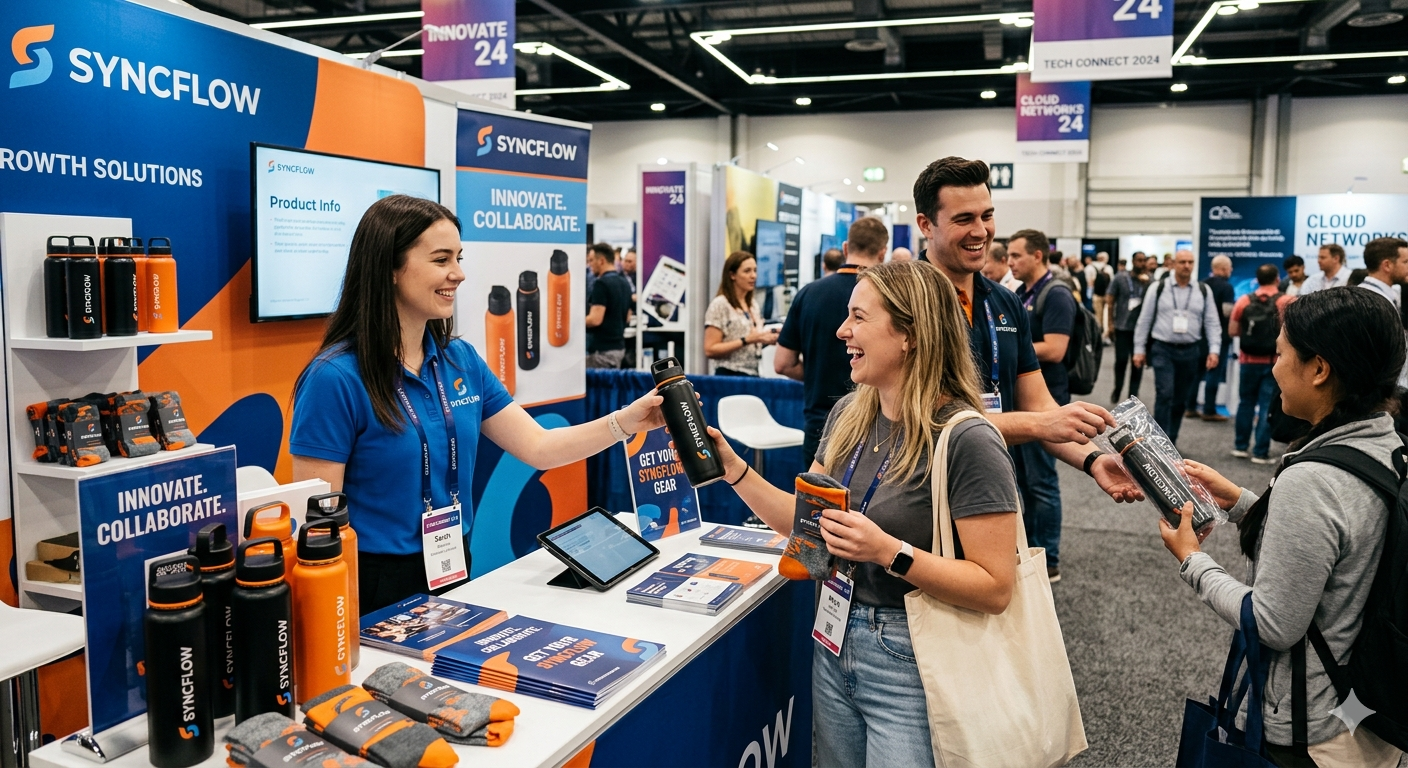
A simple booth setup works best: useful items, clear context, and no hard pitch.
If you want merch (ask like a human)
Avoid: “Can I get one?” (sounds like you’re taking inventory)
Use:
- “That’s cool—do people use this right away, or is it mostly a keepsake?”
- “What do you usually do with these first?”
If they don’t engage:
- smile + “All good—thanks.”
Don’t force it. Merch should not become your entire networking event plan.
If you’re giving merch (give context)
Avoid: dumping swag with no sentence.
Do this instead:
- “I’m handing these out because it pairs with our checklist—want the one-page version?”
Or (when you’re the one giving the item—put the buyer first):
- “There’s a short tip on here—if you tell me what you’re selling or demoing right now, I can show you the one line that fits your situation.”
You turned merch into usefulness. That’s the whole trick.
How to Capture Leads at Networking Events
Lead capture works when it feels contextual, not extractive.
Best lead-capture pattern:
- Ask for something small that helps you follow up
- Then offer a relevant next step
Soft lead capture lines:
- “What’s the best email for sending the one resource we talked about?”
- “If I send a quick template, would you rather get it at work email or LinkedIn?”
- “Are you the right person for [their exact problem], or is there someone else I should speak with?”
Avoid lead capture that feels like a transaction:
- “Can I get your card?” without a reason.
Reason makes it feel respectful:
- “I’d like to send you the example before/after story we discussed.”
If you need a full structure for turning conversations into a demo plan, start with the Demo Agenda Template.
How to Find Job Opportunities at Events
Asking “Are you hiring?” is direct. Sometimes it works. Often it makes you look like you’re trying to solve your needs immediately.
Indirect approach: lead with the problem they own.
Lines you can use:
- “What kind of hires help you most right now—more strategy, more execution, or more engineering depth?”
- “What are the biggest demo or rollout challenges your team is facing this quarter?”
- “When candidates are successful in your team, what do they tend to be strong at?”
Then only one gentle ask:
- “If I’m aligned, would it be okay if I shared my background so you can point me in the right direction?”
This keeps it problem-led, not self-led. It also gives them a role-based way to respond.
Speaking at a Marketing Event: What Actually Works
Most speakers open with a corporate statement. Don’t do that at conferences.
For the actual flow of a live demo or pitch—problem → proof → close—start with how to structure a presales demo. That article is about demo structure, not “networking,” but the same idea applies: one clear story beats a slide of logos.
Use openings that sound like an observation:
- “Most teams don’t lose because their product is weak—they lose because the story arrives too late.”
- “If your audience is impressed and still unconvinced, you’re probably teaching before you’re positioning.”
- “The fastest way to kill momentum is to lead with what you built instead of what the room is afraid of.”
Then tell a short story:
- before (what’s broken),
- shift (the idea),
- proof (the moment it changes),
- one-line takeaway.
Storytelling beats corporate tone because people remember moments, not marketing slogans.
If you want a repeatable walkthrough, structure your story into one clear before → shift → proof story.
Networking Event Follow-Up: What to Do After
Networking at events is only half the job. The other half is follow-up timing.
The best follow-up is within 24 hours.
Why 24 hours?
- Your conversation is still fresh.
- They’re still collecting notes from the event.
Example message (copy-paste ready):
Subject: Great talking at [Event Name]
Hi [Name]—it was a pleasure chatting at [Event].
You mentioned that demos feel too fast before buyers understand the problem.
Here’s the simple before/after story we discussed: before → shift → proof.
If it helps, I can also share one example you can adapt for your next session.
Thanks,
[Your Name]
Keep it short. Reference one detail. Offer one next step.
FAQ: Networking at Events
How do I start a conversation at a networking event?
Start with event-shaped questions, not resume-shaped ones:
- “What brought you here?”
- “Which session are you excited about?”
- “What’s the one problem you hope to solve this quarter?”
How do I exit a conversation politely?
Exit while it’s still valuable:
- “This was helpful—mind if I send that resource?”
- “I’ll let you get back to the room. What’s the one takeaway you want to remember?”
How many people should you meet?
Aim for fewer, deeper moments. One strong conversation can outperform ten quick ones because it creates memory and follow-up potential.
How should I follow up after an event?
Follow up within 24 hours. Reference one detail you talked about and include one useful next step. Don’t ask for a call on the first message—earn the next step.
Optional: if you want more networking event tips, pick one section above and practice it for the next two conversations only. Then repeat.
Bonus: Colleagues, pre-event meetings, and LinkedIn
Your colleagues at the event
Split roles so you don’t all talk over each other:
- One person owns booth or hallway conversations; another catches sessions and notes one quote worth repeating.
- Short debriefs (two minutes): “Who did we promise to follow up with?” beats “How was your day?”
Meetings before the event
You don’t need a packed calendar. One or two short, specific slots help:
- “I’m going to [Event]. If you’re there too, want 15 minutes coffee Tuesday morning to compare notes?”
- Book with people you already know or warm intros—not cold spam. The goal is a real conversation, not a pitch.
LinkedIn after (not a brag wall)
One post beats ten stories. Keep it useful:
- One takeaway from the event (a line you heard, not “great event!”).
- One question you’re still thinking about.
- Tag people only if they agreed—no surprise tags.
More from DemoSecret (short reads)
- How to structure a presales demo — order your story before you open the laptop.
- How to prepare for a demo — so the event conversation turns into a real demo later.
- Common demo mistakes — what quietly kills trust (useful context after you meet someone new).
Final note
Networking at events gets easier when you stop trying to “sell” in the hallway. You’re not selling. You’re positioning—through curiosity, clarity, and a clean exit.
If you want a structured way to apply this to your next presentation, use our Demo Checklist Generator.
Your demo isn’t converting.Get a Demo Audit.
We’ll review your live demo or product video and show you exactly what’s losing your audience — and how to fix it.
Built for real demos, not generic advice.
Pinpoint the problems
We find the exact moments where your demo loses momentum.
Get specific fixes
Clear, practical recommendations you can apply right away.
Drive more yes
A better demo experience that leads to more conversions.
Tags
Want to run better demos?
Get practical frameworks and tools used by presales teams.
Get the ChecklistContinue learning:
Related Articles
Demo Mistakes • March 20, 2026
7 Software Demo Mistakes That Kill Deals (And How to Fix Them)
The software demo mistakes that cost presales deals—plus fast fixes. Covers weak opens, messy flows, bad closes, and when feature dumping needs a dedicated playbook.
Demo Strategy • March 20, 2026
Demo Delivery Techniques
The mechanics of how you present: voice, pacing, screen hygiene, and handling interruptions so your demo lands.
Demo Strategy • March 20, 2026
How Long Should a Demo Be
How long a demo should run—and how to budget time inside your demo structure so the walkthrough, value, and close all get air.