

Presales Career
May 23, 2026
Sales Engineer Salary
What sales engineers earn in 2026—US, Australia, and New Zealand bands, base/OTE splits, super/KiwiSaver, AE comparison, and how to read presales vs industrial titles.
You may not have heard of sales engineering yet—and that is partly why the pay surprises people. The role does not trend on LinkedIn. In practice, it is the person who presents and sells software products. Solutions engineer, presales consultant, demo specialist—titles vary, but the work is the same. For people who are good in front of a room, it is often where the big bucks quietly pile up, close to revenue without living entirely on quota.
You are comparing two sales engineer salary offers.
One says $105k base and $125k OTE.
Another says $189k base and $270k OTE.
Same job title on LinkedIn. Same “Solutions Engineer” badge in Slack.
So which number is “real”—and where do you actually land?

Sales engineer pay is rarely one number. Base, variable, and equity each tell a different part of the story.
The honest answer: both can be real at the same time. Sales engineer compensation spreads wider than most job posts admit. What matters is how the package is built, who you are selling to, and where you sit on experience and segment.
What “sales engineer salary” usually means
Before you compare offers, align on vocabulary. Recruiters mix these up on purpose sometimes—not always maliciously, just fast.
Base salary — Fixed cash every paycheck. For many SE roles this is 70–80% of on-target pay (unlike account executives, who are often closer to 50/50 base and commission). A higher base usually means less upside when the team crushes quota—and more stability when they miss.
OTE (on-target earnings) — Base plus variable pay if you hit plan. That is the number on the offer letter people quote at dinner. It is not a guarantee.
Total comp (TC) — OTE plus equity (RSUs, options, refreshes) and sometimes bonuses that are not tied to quota. This is the number that actually funds your life—if the equity is liquid and the variable pays.
Stock — Ask what kind: RSUs at a public company (real dollars on a schedule) vs options at a startup (worth something only if the company wins). Early-career SE packages sometimes lean heavy on stock because the company is still figuring out how to pay the role.
If an offer only says “OTE,” ask for base, variable split, and equity in writing. You cannot benchmark without all three.
Why sales engineer salary feels confusing
You are not alone if Glassdoor, recruiters, and this article seem to disagree.
A common story: mechanical engineering background (bachelor’s + master’s), ~2 years in R&D, interviewing in a midwest market like Detroit, targeting testing, manufacturing, or industrial vendors—not cyber SaaS. You ask for a normal entry base and get silence or a range that does not match what you read online.
Here is why.
You are probably comparing different industries
Most presales salary talk online is SaaS—cyber, observability, dev tools. Mechanical / manufacturing / test-equipment SE pay is a different animal:
| Factor | SaaS presales (typical) | Manufacturing / industrial SE (typical) |
|---|---|---|
| Base / variable split | 70/30 or 80/20 | Often 90/10—more stable base, smaller commission slice |
| Entry OTE (software lens) | ~$100k–$150k total can be a solid first offer | May land lower than typical SaaS presales bands suggest; can still be a strong step up from R&D |
| Starting base (software bands) | Many cite ~$110k–$150k base depending on background | Varies by vertical; use local Glassdoor and state wage-range postings |
| Volatility | Quota and team attainment swing variable more | Often steadier paycheck, less “lottery” |
Same title. Different economics. Do not benchmark a Detroit test-systems offer against a Bay Area NDR post.
The same job title can be $60k apart
Even in tech sales, two major vendors hiring the same SE level have shown ~$60k OTE spread for similar work—because they value pay differently, not because your benchmark was wrong. Job posts make it worse: some list OTE, some list base only. Always normalize to base + variable at 100% + equity.
Base vs commission: what to expect
Market standard for SaaS SE is usually 80/20 or 70/30 (base first number). If someone offers 60/40, it is fair to ask why you are not an account manager—that split starts to look like sales ownership.
Account executives are typically 50/50. SE base is often higher than AE base in dollars, but AE OTE still wins when deals land (see the SE vs AE section below).
Masters degree: helpful for credibility, especially in engineering-heavy products—but many hiring managers say it carries little weight in salary negotiation compared to presales or customer-facing experience. With ~2 years in R&D and no SE title yet, expect level-1 bands. The play is get in, prove demos, jump in ~2 years.
Team commission vs individual (ask this in every interview)
| Model | Upside | Downside |
|---|---|---|
| Team quota | Smoother pay, collaboration, commission sometimes starts sooner when you are new | You may not capture the full upside of a “career year” solo |
| Individual / tied to your AE | Big year if you land a rockstar rep or whale account | ~$5k variable in a bad year if your rep struggles |
Brand-new SEs have been surprised—happily—when 70/30 and $200k+ OTE on paper turned out to be team-based, so variable was not “wait until I personally carry a number.” Always ask how commission is calculated before you compare offers.
Entry-level anchors (software vs your vertical)
From a software presales perspective, ~$100k–$150k OTE as a first SE role is often described as strong. Base-only bands of ~$110k–$150k show up for hires with relevant background—then variable stacks on top.
A 2017 cyber first offer at ~$85k OTE (70/30) is now cited as roughly triple after years in-seat and job moves—illustrating why first number ≠ career ceiling.
For machining, testing services, manufacturing reps, use industry-specific research (Glassdoor, Blind/Fishbowl, local peers). Foot-in-the-door beats waiting for a SaaS number that does not exist in your vertical.
Mechanical engineers: one path people mention
Commercial HVAC (and similar building / mechanical sales) is not the same as SaaS SE—but for Mech E + people skills + money motivation, some offices are 100% commission with a guaranteed draw (high upside, high commitment). Others are base + commission. Only you know if draw-based pay fits; it is optional, not required, to “be” a sales engineer.
Role clarity (so you compare the right job)
Titles blur across companies. Roughly:
- Account manager (AM) — existing book, renewals, upsell, relationship + quota (retention, ARR, etc.).
- Account executive (AE) — new logos, proposals, negotiation; volatile, celebrated wins.
- Sales engineer — technical discovery, demos, POCs, RFPs, roadmap feedback; usually least volatile unless you are clearly tied to a lost deal (blame gets passed around anyway).
Also ask AE:SE ratio and segment: transactional books mean more demos and faster wins; enterprise means longer cycles, heavier POCs, fewer accounts—and different boredom/burnout tradeoffs.
Practical research checklist
- Name your vertical (SaaS cyber vs manufacturing vs test equipment).
- Name your geo (Detroit ≠ SF; use local ranges).
- Get OTE and split in writing; confirm team vs individual variable.
- Check whether the listing shows base or OTE.
- Use Glassdoor plus states that require salary ranges on postings.
- Treat offer #1 as learning—technical skill matters, but so do yes/no answers, “let me check,” and not over-engineering every call.
Sales engineer salary vs account executive (what’s normal)
You sit next to your account executive on a deal. Their offer letter looks like yours—but the gap is bigger than you expected.
A real pairing people compare:
| Role | Base | OTE |
|---|---|---|
| Sales engineer | ~$170k | ~$240k |
| Account executive (same team) | ~$180k | ~$360k |
Only ~$10k separates base. ~$120k separates OTE. That freaks out SEs who were told “we get higher base.” Sometimes true on pay mix; not always true on base dollars, especially when the AE is senior enterprise and you are mid-level IC.
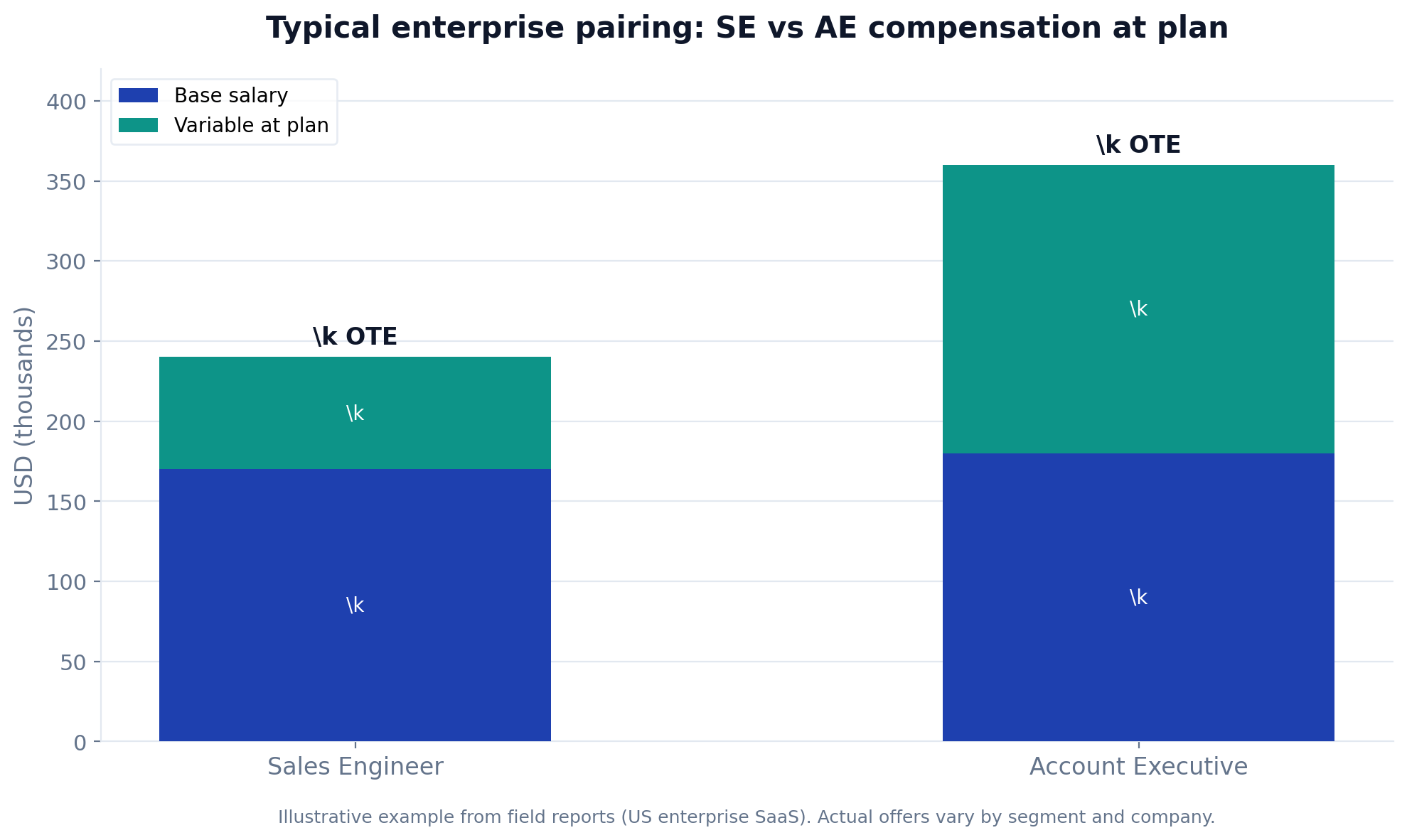
Typical enterprise pairing: similar base dollars, very different variable at plan—why OTE gaps surprise new SEs.
The usual split: more base for SE, more upside for AE
| Role | Typical pay mix | What it means |
|---|---|---|
| Account executive | 50 / 50 base vs variable | More leveraged. Bigger check when the team crushes—and more pain when they miss. |
| Sales engineer | 70 / 30 or 80 / 20 | More base as a share of OTE. Less variable at plan. Less “eat what you kill” per deal. |
All else equal, a strong AE will out-earn a strong SE. Not because demos are worth less—because risk and quota ownership are priced differently. When deals close, commission and accelerators flow to the person whose name is on the number.
Enterprise benchmark many cite for average tech AEs: about $150k base / $150k variable ($300k OTE). A hot rep can run $30k–$50k higher on each line. Senior SEs land in the same zip code as mid-market reps at plan; principal SEs can beat mid-market AEs but still often lose to enterprise AEs who are fully ramped and hitting accelerators.
When the gap gets brutal (same deals, different checks)
On a 1:1 book—one SE, one AE—the story hurts clearest:
- You run the demo, POC, and technical win. Creative work on weird use cases. Stage-by-stage proof.
- The year ends: ~$320k for you, ~$750k for them on the same deals.
That is not a broken spreadsheet. It is plan design. Leadership will shrug and say that is how it has always been—and offer to move you to AE if you want the upside. Some SEs try hybrid “wear both hats” (pipeline review, forecast calls, CRM hygiene) and hate it. Others were AEs first, made money, and came back to presales for life outside work.
Segment flips the story
- Mid-market: SE OTE above the AE on the same pod happens. You are closer to quota in the room; the rep’s variable may be smaller or shared differently.
- Enterprise: AE base often leads by ~$10k+ (or more) and OTE pulls away. AE level matters: an AE1 can earn far less than a senior SE even with commission; an AE4 can take a single commission check that equals your entire year’s cash.
One senior SE described ~$280k target comp (~70% base) while paired AEs sat $450k+ OTE with 50% base—but higher commission rates on overachievement. You will not close that gap by demo polish alone unless you renegotiate (rare %‑based SE plans) or change role.
Why companies map 2–3 AEs to one SE
Pooled coverage is partly economics: if every SE had 1:1 accelerators like a rep, total variable would balloon. Instead many orgs pay SE variable across two or three AEs, sometimes plus a regional or segment component to smooth OTE. You trade solo upside for less feast-or-famine than a rep on a lone number.
Risk you are not paid to ignore
Reps live on a moving target every quarter—VP of sales adds stretch, pipeline scrutiny, dinners and games four to six nights a week for some books. Miss long enough and you are out (often after a grace quarter or two; startups can cut faster). SEs are not immune to layoffs, but many veterans report more stability: calendar fills, you are not cold calling, and in flat years you can still be fine while half the rep roster churns—reps who never even hit plan, let alone accelerators.
Sales is also fired first in bad markets. Higher OTE is partly pressure insurance, not a gift.
Should you become an AE for the money?
Honest filters:
- Half the SEs people know would be bad AEs—too blunt, too honest, too focused on the right answer when the buyer wants ego and politics managed.
- Many AEs are struggling; the top of the leaderboard drives the myth. You might trade $240k and sleep for quota roulette.
- SE upside without switching: principal IC, %‑based comp at the right shop, or paths into architecture / customer engineering / leadership at “normal” companies (sometimes former clients).
If you want AE money, apply and try to hit their OTE before you assume it is easy. Job security often favors reps who are well liked by sales leadership and buyers—not only closers.
Most experienced SEs choose the trade: lower ceiling, higher floor, no monthly hunt, and step away after hours. Worry about your number—not your rep’s best quarter—unless you are actively planning a move.
What people are actually earning (2025–2026 market check)
These ranges come from what practicing SEs report in the field—not from a single employer’s careers page. Treat them as directional, not gospel.
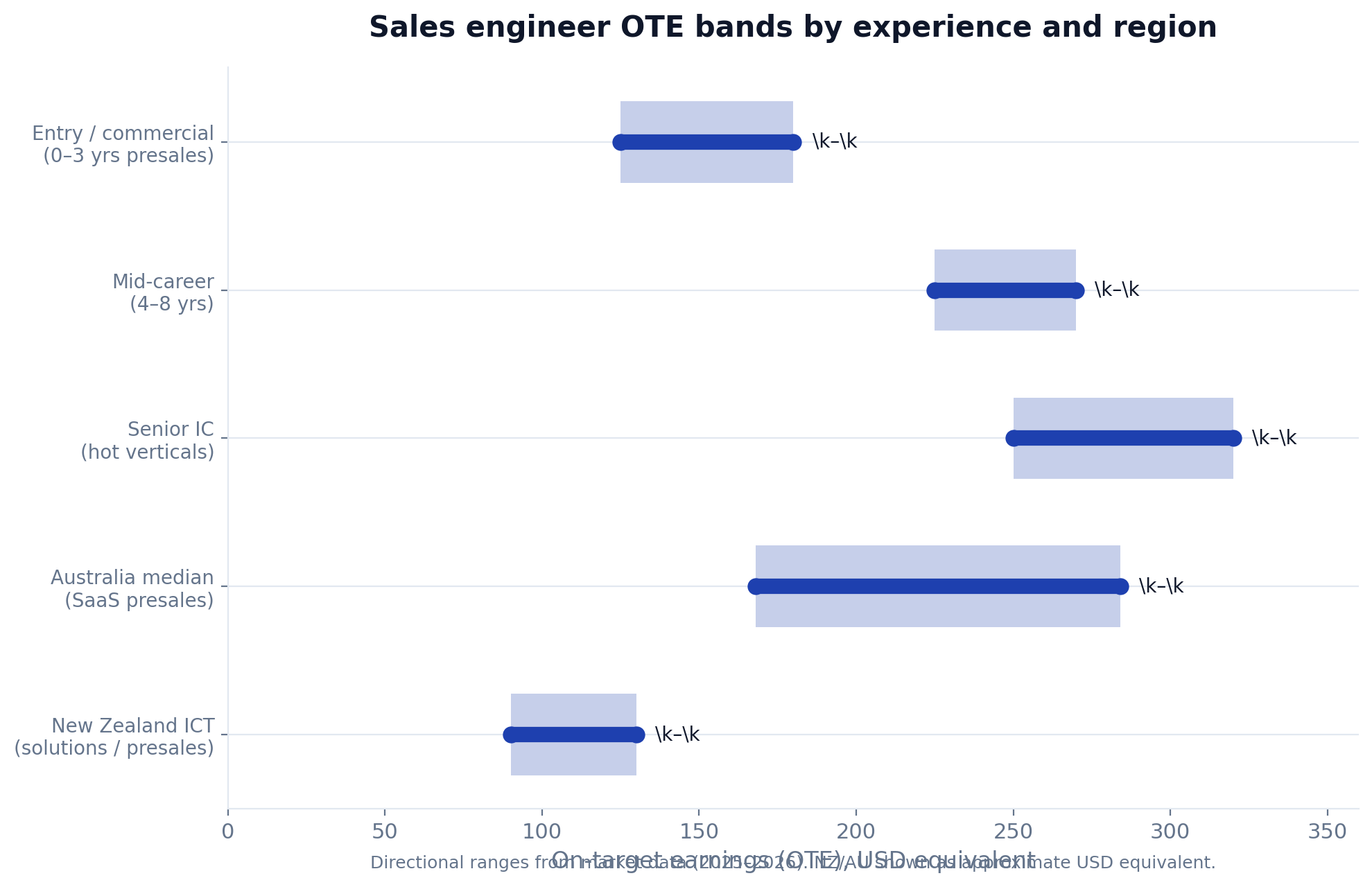
Directional OTE bands by experience and region (2025–2026). Your offer depends on vertical, pay mix, and whether the title is SaaS presales or industrial sales engineering.
Base salary ranges recruiters are offering now
If you are interviewing today, you are not crazy when bases sound all over the map. People actively in loops report recruiter base offers from about $75k to $130k on the low band—while passive candidates in hot verticals see inboxes closer to $225k–$270k OTE (usually ~$150k–$200k base on a 70/30 split). Same job title. $40k to $400k+ is possible if you fold in geo, niche, seniority, and whether the role is real presales or a catch‑all.
Without location, segment, and seniority, any single number is noise. With context, patterns show up.
The two-band market (experienced ICs)
Many people describe a gap in the middle:
| Profile | Typical OTE band | Base (implied 70/30) |
|---|---|---|
| Experienced presenter, lighter hard skills | ~$150k–$180k | ~$105k–$125k |
| Strong technical SE (APIs, demo eng, integrations) | ~$220k+ | ~$155k–$200k+ |
If your inbox only shows $125k–$150k OTE, you might be filtered for geo, keywords, or profile shape—not because senior cyber roles stopped existing. A lot of $250k+ seats never hit public job boards; they fill through headhunters and warm intros.
What “senior” base looks like in US interviews (2025–2026)
Recent offer data points people compare in loops (always verify split and equity):
| Level / context | Base | OTE | Notes |
|---|---|---|---|
| NYC cyber, experienced SE | — | $225k–$280k | 70/30 common |
| Sr SE, cyber, remote (e.g. CA) | ~$206k | ~$275k | 75/25; multiple similar offers |
| Sr SE, enterprise interviews | — | $250k–$260k | Some report lower than a year ago at same logos |
| Sr SE, OEM / infrastructure | — | ~$275k | 70/30 |
| Sr / lead, big public SaaS | — | ~$280k | ~$75k RSUs over 4 years |
| CrowdStrike-style cyber (NYC area) | — | ~$270k–$275k | ~$120k RSU / 4 yrs (~$30k/yr); ~$300k TC at plan |
| Current seat + accelerators | ~$155k | Plan + variable | One Q3 accelerator alone ~$71k–$80k when team crushes |
| Interview stage (second-to-last round) | $160k–$200k band quoted | 70/30 | Coming from ~$140k base today |
| New role (~6 months in) | — | ~$215k | 70/30 |
| Fast startup | — | ~$250k | 70/30; chaos tax applies |
| DACH enterprise, big tech | ~€120k | ~€150k | Most local SEs not near this |
| Australia, principal, major cyber vendor | ~$170k USD equiv. | — | See Australia and New Zealand for local bands |
Floor many US candidates cite: about $110k base in a normal cost-of-living market before they will engage—below that, the role has to be a deliberate stepping stone. In lower-cost midwest markets and manufacturing / test-equipment verticals, entry base can sit below that and still be reasonable for first presales—compare to your current R&D pay and local roles, not only coastal SaaS bands.
Internal growth vs job hop (base in practice)
One NYC arc without changing companies every year:
| Milestone | Base |
|---|---|
| Hired (~4 years ago), no SE title | ~$90k (felt lowballed) |
| Year 1 raise | ~$105k |
| Promotion | ~$140k |
| Latest raise | ~$150k |
Recruiters in the inbox cluster $150k–$200k OTE—not always worth a call if you are already there. The bigger jump often comes from company change: transfer/lowball (~$120k base in NYC) → internal path to ~$250k with bonus, or Singapore → NYC → London with a retention bonus and a move after the contract ends when life goals shift.
Rule many veterans repeat: incremental raises cap out; after ~4+ years, the largest base bump usually comes from switching employers—unless you are chasing a principal title at a huge logo and the promotion is real, not a retention story.
Hiring feels frozen—but qualified SEs still get pinged
People talk about layoffs and hiring freezes while still getting 3–5 recruiter messages a week for Series B–D funded shops. The mismatch is usually qualification, not job count:
Most demo mistakes are predictable. Run the checklist before your next customer call.
Generate my checklist- Startups want a “one person army”: sell, solution, build demo environments, sometimes implement or code against APIs (closer to forward-deployed or post-sales than classic presales).
- Ten years of software development before SE still wins—custom demos, integrations, high-performing reps routing hard deals to you.
- Presentation-only profiles often stall: strong on stage, 50+ applications, silence. Fix: put demo engineering (VMs, malware labs, integrations, scripting) on the resume; learn enough API/scripting to wire realistic stories (e.g. DLP logs into a SIEM).
There are many applicants and few truly qualified SEs—one of the hardest roles to hire for. Opening up to implementation / post-sales hybrids can mean more at-bats at smaller companies.
Why your recruiter number may not match the job post
Common frustration: recruiter DMs say $125k–$150k OTE while you are already at that total comp—so you do not reply. Public listings rarely show $225k–$270k bands; those roles are often privately filled. Always ask base first, then OTE, then equity—recruiters lead with OTE because it sounds bigger.
Companies squeezing pay: several senior candidates report big-name enterprise interviews landing $250k–$260k OTE when they used to see ~$275k for the same level—worth tracking in your spreadsheet, not ignoring.
Territory and product still move base
The shiniest AI platform pays like average tech if the territory is brutal. Patch, industry, and who the company sells to matter as much as the logo. Rural US on a strong package can beat coastal stress on take-home even when the base number looks smaller on paper.
Entry and commercial (roughly 0–3 years in presales)
Typical shape for commercial segment, observability, DevOps, or cyber SaaS in the US:
| Component | Common range |
|---|---|
| Base | $105k – $150k |
| OTE | $125k – $180k |
| Stock (annualized) | $5k – $25k at public cos; more at startups |
| Total comp (hitting plan) | ~$150k – $190k |
Example that fits this band: $105k base, $125k OTE, about $15k/year in RSUs plus a small refresh—~$150–155k total when attainment is above plan, with under two years in the seat but hired green. Panels at large vendors (Oracle, Salesforce, Workday-style college programs) often land around $125–130k base in NYC or SF for first roles—not higher unless you negotiate hard.
That is not “low.” It is commercial, early tenure. Enterprise and strategic roles pay differently.
If you are in active interviews with little tenure, $75k–$130k base is the band many people report hearing from recruiters—wide because some offers are low COL, reseller, or blended implementation roles wearing an SE title.
First-year reality checks from the same band: ~$110k OTE with only a couple months in seat; ~$130k OTE in cyber with two years; $75k salary + $25k bonus where the bonus is company-performance, not commission—and people openly say they will not see the full $25k in a bad year. $100k OTE flat shows up too when variable is thin or attainment is soft.
How pay often climbs (one person’s arc)
Titles stay “Sales Engineer.” Cash does not move in a straight line. One common US progression people describe:
| Stage | Base | OTE |
|---|---|---|
| Starting out | ~$80k | ~$105k |
| Early–mid | ~$95k | ~$125k |
| A few years in | ~$125k | ~$155k |
Another path on the East Coast: ~$88k base and ~$100k total right out of college at a large company → startup → big tech, and within about five years land ~$165k base and ~$260k total comp. That is not automatic—it is segment jumps and proof in the room, not tenure alone.
Internal moves count: sales-to-SE with no prior presales title might show ~$135k OTE while teammates on the same mid-market data platform clear ~$175k when they are hitting plan. You are not crazy if your first SE number lags people who were already demoing full-time.
Mid-career (about 4–8 years relevant, several in presales)
| Component | Common range (US, strong verticals) |
|---|---|
| Base | $165k – $200k |
| OTE | $225k – $270k |
| Stock | $20k – $45k/year (varies wildly) |
| Total comp (at or above plan) | $250k – $320k+ |
Cybersecurity, observability, infrastructure, and data/AI platforms cluster here. Someone with ~7 years in industry and 4 as an SE in OT cyber might show $185k base, $250k OTE, plus options worth roughly $20k/year. Another in CNAPP with an 80/20 split might post $200k base, $50k variable at plan, $250k OTE, and ~$30k in annual option value.
Senior / crushing quota
Top of band when product sells and comp plan is not pooled into mediocrity:
- $198k base, $265k OTE, $45k equity in a year at a networking company—with 3 years as an SE and strong attainment.
- Cyber SaaS with 12 years industry, 2 in presales: $182k base, $260k OTE, $40k stock, ~$300k total when the team is beating plan.
- Senior SE at a major cloud data platform: $250k–$290k OTE before equity—then a $170k–$200k RSU grant spread over four years (~$42k–$50k/year), plus annual refreshes for top performers (one year ~$79k in refresh alone). OTE on the letter is only part of the story.
- Principal SE at a late-stage database startup: ~$300k OTE plus equity on top.
- Network/security veteran (~10 years as an SE, after pro services and IT leadership): $170k base, $75k variable at plan—$245k OTE when the split is spelled out clearly.
Industry compensation surveys by years of experience (e.g. annual presales comp reports) line up with what people report anecdotally in the field: band shifts at ~3, ~5, and ~8+ years, with the widest spread at senior IC and principal levels.
Enterprise vs mid-market (rule of thumb from long-tenure SEs): out of college into a mid-market org, many land around ~$100k base + ~$50k variable/bonus—call it ~$150k all-in when healthy. Enterprise software or hardware in large orgs often runs $150k–$200k base plus commission and bonus; senior enterprise SEs in hot verticals can land $250k–$500k+ when caps and accelerators are real (always ask where the cap is).
Variable math: for many US roles, variable is roughly 25–35% of OTE. “200% of OTE” in casual talk usually means crushing variable and accelerators—not doubling a $250k paycheck unless the plan actually pays that way. Cyber SEs who say they have never been under 100% quota are describing attainment, not a separate job title.
Get better at demos
Practical ideas, teardown lessons, and tools for people who present software.
Get the ChecklistWhy two SEs with the same title earn different money
Segment: commercial vs enterprise
Commercial deals are smaller and faster. Comp bands are lower; ramp is quicker. Enterprise and strategic SEs support fewer, bigger deals—often higher base and OTE, but fewer roles and higher scrutiny in interviews. Moving from commercial to enterprise is one of the cleanest ways to jump bands without changing industry.
Industry and product heat
Observability, security, data/AI, and core infrastructure tend to pay more than generic ad tech or thin-margin resell. VAR/reseller roles often sit lower (~$135k base, ~$180k OTE, small stock) unless you own a niche practice.
If nobody on the sales team hits quota, your variable is a fantasy. SEs in pooled commission models feel this hardest: your check can average across three or four reps, and a weak product year drags everyone down even when you personally carried the demo.
Location
US tech hubs still lead for cash on a purchasing-power-adjusted basis, but Australia and New Zealand have real presales markets—if you search the right job titles. London examples in the same market check landed around £85k–£120k OTE plus stock. Canada is its own market: manufacturing SEs at ~$55k base and ~$75k–$80k OTE as a stepping stone are common. Comparing US OTE to EU, ANZ, or Canadian salary without tax and cost-of-living context will make you miserable for no reason.
See Australia and New Zealand below for local bands. Singapore APAC HQ roles in data analytics have shown ~$240k SGD (~$188k USD) OTE—useful context if you are comparing across Asia-Pacific, not a stand-in for Sydney or Auckland.
International gap (honest): the big OTE numbers you see in US salary roundups are US-based. Ten-plus years in India or the Gulf can still mean low four figures USD annually in some markets; emigrating without sponsorship is hard, and customer-facing presales visas are rarer than engineering visas. If you are outside the US, benchmark locally first, then decide whether relocation or remote-for-US-company is the play—not the headline on a San Francisco job post.
Australia and New Zealand
ANZ pay is not one number—and the words on the job ad matter as much as in the US.
On SEEK (May 2026), employers disclose salary ranges on live ads. Some figures include superannuation (Australia) or benefits; some are base only. Always ask: “Is that package including super?”
| Title on the ad | What it usually means in ANZ |
|---|---|
| Sales Engineer | Often industrial, OEM, mining, HVAC, pumps, automation—lower averages on SEEK |
| Presales Engineer / Solutions Engineer | Usually ICT / SaaS / cyber—closer to US-style presales comp |
| Technical Sales Engineer | Mixed—read the employer and industry |
Do not compare a Perth mining “Sales Engineer” ad to a Sydney Splunk presales role and wonder why the spread is A$90k vs A$160k+.
Australia (2025–2026 market)
Software / presales-shaped roles (RepVue, May 2026—all figures AUD):
| Metric | Typical range |
|---|---|
| Median base | ~A$161k |
| Median OTE | ~A$225k |
| Base band (reported) | ~A$127k – A$200k |
| Total earnings potential at plan | ~A$168k – A$284k |
| Strong performers (top of dataset) | up to ~A$350k total |
RepVue’s Australia sample has tracked roughly in line with US medians on base and OTE—not identical, but the same order of magnitude for enterprise SaaS / cyber presales.
Levels.fyi (Australia, sales engineer, updated mid-2026) shows ~A$213k average total compensation with a wide band (~A$115k – A$243k)—useful for vendor / tech employers that show up on that site; thin for industrial roles.
SEEK disclosed averages (job ads, 2026):
| Role / lens | What SEEK shows |
|---|---|
| Presales Engineer (top locations on ads) | Up to ~A$162.5k in highest-disclosure markets; lower bands ~A$90k – A$125k on many listings |
| Sales Engineer in ICT industry | ~A$143k average on disclosed ads |
| Sales Engineer (all industries blended) | Much lower in manufacturing / trades categories on the same site |
| Pre Sales Technical Consultant (PayScale, AU-wide) | ~A$112.5k average base; early career totals ~A$121k |
City reality check (same title, different worlds):
| City | PayScale “Sales Engineer” (mostly base, 2026) | How to read it |
|---|---|---|
| Sydney | ~A$100k avg base (~A$64k – A$175k) | Industrial and OEM listings pull the average down; presales cyber sits higher |
| Melbourne | ~A$80k avg base (~A$61k – A$130k) | Same split—check employer before you benchmark |
Field anecdote (principal, major cyber vendor): ~A$170k USD-equivalent base has been reported for principal level at a large vendor—useful as a senior IC anchor, not an entry offer.
Superannuation (critical): Australian employers pay super on top of most full-time packages (rate set by law, ~11.5% in the 2025–26 period). A job at A$150k + super beats A$150k including super by roughly A$17k in employer contributions. Normalize every offer to base + super + variable.
Splits: Same as global SaaS norms—70/30 or 80/20 for presales; team vs individual variable still worth asking.
Remote / hub notes: Sydney and Melbourne concentrate vendor presales (Mimecast, Splunk, Zscaler, Microsoft, etc. on recent SEEK listings). Perth / Brisbane / Adelaide skew resources, industrial, and OEM—often lower base, sometimes strong total pay in boom cycles.
New Zealand (2025–2026 market)
New Zealand is a smaller market than Australia. NZD packages are typically lower than Sydney/Melbourne presales for comparable logos—but ICT solutions roles still beat many general “sales engineer” industrial ads.
SEEK (May 2026, disclosed ad averages):
| Role / lens | Typical figures (NZD) |
|---|---|
| Solutions Engineer in ICT | ~NZ$115k average on disclosed ads |
| Solutions Engineer (top Auckland regions on ads) | ~NZ$112.5k – NZ$130k in leading pockets; ~NZ$97.5k in some suburbs |
| Presales Consultant (related title) | Often cited around ~NZ$113k typical on SEEK career pages |
| Sales Engineer (top locations on ads) | Up to ~NZ$130k in some Auckland corridors; ~NZ$90k – NZ$105k common on broader listings |
PayScale — Solutions Engineer (NZ, 2026): ~NZ$83k average base (~NZ$57k – NZ$120k); mid-career totals cluster near ~NZ$90k. Sample sizes are small—treat as a floor check, not the ceiling for Datacom / Cyclone / Palo Alto channel style roles.
Live job ad examples (NZ SEEK, 2026—always re-check):
- Sales Engineer: ~NZ$80k – NZ$110k base band on some listings
- Automation sales + support: ~NZ$70k – NZ$90k + uncapped commission
- Presales / outbound ICT: ~NZ$110k – NZ$150k OTE on some SaaS-style posts
- Technical Solution Consultant (base in Australia): some NZ-hired roles pay on AUD bands (~A$90k – A$110k appeared on a listing)—read the contract country
KiwiSaver: Like super in Australia, retirement contributions are part of the cost of employment—confirm whether the advertised number is gross package or plus employer KiwiSaver.
Auckland vs rest: Auckland (CBD, North Shore, East Tamaki tech corridors) pays the most disclosed presales/solutions salaries on SEEK. Wellington and Christchurch have ICT presales roles but fewer ads—negotiate from national benchmarks, not US Twitter.
Australia vs New Zealand (quick compare)
| Topic | Australia | New Zealand |
|---|---|---|
| Enterprise SaaS presales OTE | ~A$200k – A$280k+ common at medians for experienced ICT | ~NZ$100k – NZ$130k typical on SEEK for solutions/presales titles; top ICT higher |
| Industrial “Sales Engineer” | ~A$80k – A$140k common on blended SEEK data | ~NZ$70k – NZ$110k + commission on many ads |
| Best job boards | SEEK presales engineer, RepVue AU | SEEK solutions engineer |
| Gotcha | Super inclusive vs exclusive | Smaller talent pool; trans-Tasman roles paid in AUD |
Rough USD math for Americans reading this (rates move—verify): A$225k OTE ≈ US$145k–150k and NZ$115k ≈ US$65k–70k at typical 2026 FX, before tax. Cost of living and tax differ; the point is NZ headline numbers are not “Australia minus 10%.”
ANZ negotiation checklist
- Search Presales Engineer or Solutions Engineer, not only Sales Engineer.
- Ask OTE, split, and team vs individual commission.
- Confirm super / KiwiSaver treatment on the headline number.
- Match industry (ICT vs industrial) before you call an offer low or high.
- For visa / relocation, many ANZ presales roles want local customer presence—remote-for-US-company is a separate path from Sydney vendor SE.
If you are breaking into presales in ANZ, pair comp research with how to break into presales and interview prep—panels still hire for story before clicks, even when the paycheck is in AUD or NZD.
Experience that counts
Hiring managers weight years in presales, but they also pay for years in implementation, consulting, or domain (hedge funds, OT, networking). Ten years in IT with six months as an SE is not the same comp as ten years as an SE—but it can beat “zero YOE” entry offers if you interview like you already know the buyer’s world.
How you got the offer
Some packages are posted ranges. Others are relationship offers—known hiring manager, internal referral, boomerang. You will never see the second number on Glassdoor. That does not mean you should not negotiate; it means your network is part of comp.
Gross margin, support model, and product maturity
Comp is not only “years in seat.” Experienced SEs call out:
- Gross margin on what you sell (fat SaaS vs thin hardware resale).
- Whether you own accounts or support a pool of sellers (pooled = smoother team pay, lower ceiling).
- New product vs mature (ramp pain vs repeatable demo wins).
- Direct customer-facing vs internal-only support (customer-facing usually pays more unless you have a rare niche skill).
Same title, different economics.
Paths into the role (and what they tend to pay first)
Field SE as job #1 is rare. Most people who make real money in presales did not start as traveling SE on day one. Common on-ramps:
- Inside sales or commercial SE first, then move up when you can run a room.
- MSP or implementation background—natural fit because you already lived in customer environments.
- Internal transfer from sales or services (sometimes lower OTE at first than peers who were hired as SE).
New CS grads often hear: do not expect field presales unless the company is tiny or you get lucky. Learn the motion on inside teams, then step up.
Defense, test, or hardware engineering → SE: a common first jump is ~$65k–$70k in a cost-center engineering seat to ~$90k–$100k presales on an offer letter. That is a real raise—and many experienced SEs will still say $90k–$100k is low for the title because SaaS cyber bands start higher. Context matters: first job out of college, non-software product (HVAC, industrial, VAR), or staffing-agency outreach often lands here. It can still be the right move if you want customer-facing work and a path off pure test engineering.
Software engineer → SE: plenty of SWEs earn well; customer-facing presales can still win on cash. One pattern: ~12 years SWE at ~$180k + small bonus, then first SE year at ~$245k OTE plus a ~$200k signing RSU package and a ~$79k refresh in a strong year. Others stay in SWE and double what that SE makes—so the leap is not universal, but it is real when the company values demo-led revenue.
Evaluating a first SE offer (and the “catch”)
You might be coming from ~$67k as a test or design engineer and staring at $90k–$100k as a new sales engineer. The jump feels huge. The comments from veterans will still say that number is low for “SE” on LinkedIn—because they are benchmarking SaaS cyber, not your first presales seat.
Here is what people who made a similar leap wish they had checked first.
Is $90k–$100k “good”?
| Your situation | How to read the offer |
|---|---|
| ~1–2 years out of college, first presales role | $90k–$100k can be a strong step up from ~$65k–$70k engineering—especially if variable is real and the company is stable. |
| Software / cyber SaaS in a hub city | Often low; you may be under-leveled or the employer is saving on title. |
| Offer via staffing agency | Vet the end client, comp split, and whether you are W2 or contract before you celebrate the headline. |
| VAR, HVAC, industrial, hardware | Bands differ from $200k+ SaaS presales headlines; compare to local presales and AE-adjacent roles, not FAANG. |
Ask for OTE in writing, not just base. If they only quote $90k–$100k total with no split, clarify whether that is all base, base + small bonus, or true OTE at plan.
The real “catch” (not a hidden fee)
There is rarely a secret trap in the offer letter. The trade is the job shape:
- You are not hired to be the deepest engineer in the building. You are hired to translate, demo, and de-risk deals. “Get the technical win; let the AE carry quota” is the normal split.
- Presentation skills matter as much as technical skills—sometimes more. The jump in pay often tracks moving closer to revenue, not memorizing more specs.
- Quota exists. Even with team quota (less feast-or-famine than a lone AE number), you should ask how SE variable pays, what attainment looked like last year, and talk to someone in the same seat.
- You will work with sales people all day—pipeline, personality, politics, long questionnaires. Low-ego engineers who only want quiet deep work often struggle.
- AE turnover can mean constant re-onboarding; you may carry more of the live call while variable stays a small slice of the deal economics.
- If you are highly technical in pure software, the alternate path is SWE at a strong shop (~$200k+ at hot startups, $400k+ at top tiers)—and the longer you stay SE, the harder it can be to switch back. Median SE can still beat median dev at weaker tech employers; top SWE pay often beats top SE pay.
None of that means “do not take it.” It means go in with eyes open.
Stability: cost center vs revenue engine
Worried about layoffs? Veterans frame it this way:
- Cost-center engineering (internal tools, test, support of someone else’s P&L) gets cut when leadership needs savings.
- Revenue-adjacent presales—when you are tied to live deals and known to sales leadership—often survives longer in downturns if the company still sells. Not immune: if sales collapses, SE headcount can still go.
Practical stability habits:
- Pick a solid company if you can (growth vs backfill req, product fit, runway).
- Know the product and use cases deeply; hard work often follows money, but visibility matters too—especially in large orgs where spreadsheet people decide headcount.
- Be the SE reps and sales leaders want on their deals; “everyone asks for them” is a real career signal.
- Team quota vs solo number: team models usually mean less brutal variable swings than AE roles.
A 29-year presales veteran’s blunt version: stay where you help top-line revenue, not where you are easy to outsource as “just engineering.”
Questions to ask before you accept (~$90k–$100k or any first offer)
- Why is the req open? Growth, backfill, or churn?
- Pay mix: 70/30, 80/20, or no commission?
- How many AEs do you support? Territory and travel?
- Team vs individual quota for SEs?
- Who is the employer if a recruiter reached out?
- Path up: principal IC, enterprise SE, management—or ceiling in this niche?
If you are ~18 months into career life, many people suggest worrying slightly less about perfect stability and more about fit—then re-evaluate every 6–12 months (comp, skills, whether you miss deep engineering or miss customers).
Skills that turn a “low” offer into a higher next one
People who climb from ~$90k toward $150k+ and beyond tend to stack:
- Product — in, out, and sideways; every common use case.
- Ecosystem — what sits around your product (especially in architect-leaning roles).
- Demo and narrative — business outcome, not feature tour (demo structure, interview prep).
- Domain — how buyers make money, cut risk, or pass audits.
- Sales partnership — strategy per account with your AE, not solo heroics.
- People skills — the economic buyer is often less technical than the room; passion and clarity beat awkward precision.
Hiring managers often say: technical depth can be trained faster than bad habits or weak customer presence. Aim to be the SE everyone wants on their deal.
Pay vs hours (the trade people mention after they chase OTE)
Not everyone optimizing for OTE is happy.
- ~$80k with two years experience, 5–25 hour weeks, full remote—real, and some people keep it on purpose.
- ~$95k at similar hours vs ~$250k with 50+ hour weeks and stress that feels like 100.
After financial security shows up, some veterans say they miss the light schedule. If you are in the $80k–$95k band with time back, that is a valid outcome—not a failure—unless you are actively trying to climb bands.
The traps that make OTE a lie
Pooled commission. You support multiple AEs; payout may average their attainment. Great for teamwork, painful when one rep’s territory stalls. Related: confirm whether “team quota” means regional SE pool or your pod’s number—wording differs by company.
Assuming individual commission. An offer may show 70/30 and strong OTE but pay variable on team attainment (sometimes a pleasant surprise when you are new). Still ask—do not model your budget on the wrong plan.
No real variable. Some roles are base + annual bonus (e.g. 15% company performance) with no commission line. OTE math still works on paper; upside is capped.
“OTE” with a broken product. Language-tech and early-stage teams have reported $86k base, $112k OTE, pooled plans, and a fraction of variable paid because the team missed number. Read attainment data in interview loops if you can.
Stock that is not cash yet. Options in a flat startup are not the same as RSUs vesting at a public company. A $30k grant over three years is not the same as $170k over four at a hyperscaler—always ask vesting length, cliff, and whether refreshes are normal. Count equity in total comp only with a discount you believe in.
Weird base/variable splits. A public tech offer might show $130k base and only $75k OTE on paper because variable is labeled differently—read the plan, not the acronym.
Lifestyle trade. Remote role, $150k base, on track to ~$175k with bonus, great WLB, acquisition bump coming—that can beat a $240k OTE job with no sleep. Salary is not the only column.
“OTE” that ebbs. Veterans in cyclical businesses report most years north of $200k, but bad years exist—bonus pools shrink, caps bite, deals slip. Average your last three years, not your best Slack brag.
How to use this when you negotiate or job-hop
- Normalize every offer to base, variable at 100%, equity type, and vesting.
- Ask attainment for the SE team last year—not company revenue, SE payout.
- Name your segment in conversations. Enterprise candidates should not benchmark against commercial college hires.
- Early career: one strategic hop after 18–24 months of proof can move base $20k–$40k; too many short stints and you get labeled flight risk. Build tenure before you chase logos. After ~4 years, compare promotion at current shop vs external offer—external often wins on base if the title bump is vague.
- Ask recruiters for base first, then OTE, then RSU/options and vesting. Tailor LinkedIn to cyber, observability, or dev tooling keywords if that is your lane—or learn demo/API skills startups actually hire for.
- Interview like the job pays. Panels hire SEs who sell the need before the click—that skill correlates with people who hit variable. See how to prepare for a sales engineer interview for the demo-audition side.
Breaking in from engineering or a first $90k–$100k offer? Pair comp research with how to break into presales. Surviving ramp? Your first 30 days in presales matters more than obsessing over refresh grants in month one.
Beyond the paycheck (why people stay anyway)
Money is why people compare SE and AE packages in the first place. It is not the only reason people stay in presales.
When demos and POCs go well, you are often the most trusted product person in the room—you “save the day” for sales and the buyer. When they go badly, the blame is real and deal size makes the stress sharp. That responsibility is the job, not a side effect.
Twenty-year veterans sometimes change team, company, industry, or vertical when bored—not because pay stalled, but because the work stays interesting. Teaching pays less; presales pays more and fits a certain personality. Know which you are optimizing for.
Bottom line
Sales engineer salary in 2026 is not one number—and it is usually not the same game as account executive pay. Entry commercial US roles often land mid–$100s OTE (sometimes ~$80k–$105k earlier in the ladder) with equity pushing total comp toward ~$150k when the team performs. Strong mid-career ICs in hot verticals sit $225k–$290k OTE; seniors at top cloud and cyber shops add large RSU packages and refreshes on top. Paired AEs on the same deals can still clear $360k–$750k when accelerators fire.
Read the split, the segment, the pool, vesting, and the geography—not just the headline on the offer letter. In Australia, check super and search presales titles; in New Zealand, benchmark NZD ICT solutions roles separately from industrial sales engineer ads. In interviews, base offers may span $75k–$200k+ in the same month; recruiter OTE may lag what senior ICs actually close. Compare role and level, not just title. And if you are early, pick the path—inside sales, implementation, or internal transfer—that actually gets you into the seat before you chase field OTE on a job post.
If you want a structured way to apply this, use our Demo Checklist Generator—the same discipline that wins interviews and deals is what eventually moves your variable pay.
Your demo isn’t converting.Get a Demo Audit.
We’ll review your live demo or product video and show you exactly what’s losing your audience — and how to fix it.
Built for real demos, not generic advice.
Pinpoint the problems
We find the exact moments where your demo loses momentum.
Get specific fixes
Clear, practical recommendations you can apply right away.
Drive more yes
A better demo experience that leads to more conversions.
Tags
Want to run better demos?
Get practical frameworks and tools used by presales teams.
Get the ChecklistContinue learning:
Related Articles
Presales Career • May 20, 2026
How to Prepare for a Sales Engineer Interview
Sales Engineer interview prep for technical panel demo presentations: slides-first structure, business numbers, and mock demo tips. Do NOT do feature tours.
Presales Career • March 31, 2026
How to Break into Presales (From Any Background)
A practical guide on how to get into presales, understand the presales career path, and become a presales engineer without following one perfect route.
Presales Career • March 31, 2026
The Presales Playbook (Career Edition)
How to break into presales, survive your first demos, and build a career that stands out - through real moments that actually happen.