Presales Career
May 20, 2026
How to Prepare for a Sales Engineer Interview
Sales Engineer interview prep for technical panel demo presentations: slides-first structure, business numbers, and mock demo tips. Do NOT do feature tours.
Most Sales Engineer interviews are not really interviews. They are demo auditions. No, not like an episode of Americal Idol where contestants smile nervously and try to impress strangers with outlandish feats. Then someone dramatically removes their sun glasses to break into an applause.
Rather it is a what i call 'Shark Tank' meets school presentaion - you job is to explain Netflix to your parents and somehow make them believe that it will boost quality family time and reduce arguments. it may sound like i'm kidding - but its kinda true.
In these interviews Panels are not grading whether you memorized the product. They are watching whether you can sell the need for it—same as a live presales demo on the job.
Communicate why the customer needs the product more than what the product is.
That one shift is the whole game.

Sales Engineer interview prep: build your slide deck (agenda, customer numbers, why the product) before you share screen for the live demo.
How I learned this the hard way
Early in my career I did a technical panel interview at a company that may or may not have had a cloud in the logo..you know which one i'm talking about.
Fifteen minutes. Any product I knew. Pretend they were the buyer.
I shared my screen, opened the app, and started clicking. Four minutes in I was narrating settings like anyone had asked for a product tour. When someone asked how this helps a VP of Sales, I showed another feature.
Feature dumping. No business story. No numbers. No agenda.
I did not get the offer. Feedback was blunt: You opened the product before you gave us a reason to care.
Seasoned SEs lose the same way. Two candidates can both click well. The one who frames money, risk, or time wins. Sales leaders want SEs who see the bottom line—not only the admin console. More on that pattern in how to avoid feature dumping.
Split the interview into three parts (slides first, demo second)
Most Sales Engineer demo interviews ask you to present a product you know, or a trial of theirs, with a real or invented customer. Same structure works for both.
Put everything before the live demo on slides. Cap it at 5–7 minutes total. Then share screen for the software demo.
- Part 1 — Intro / agenda (slides)
- Part 2 — Customer overview — challenges and gaps (slides)
- Part 3 — What the product is, why it matters, and demo outline (slides)
- Part 4 — The demo (live product)
- Part 5 — Close and next steps (slides or spoken wrap-up)
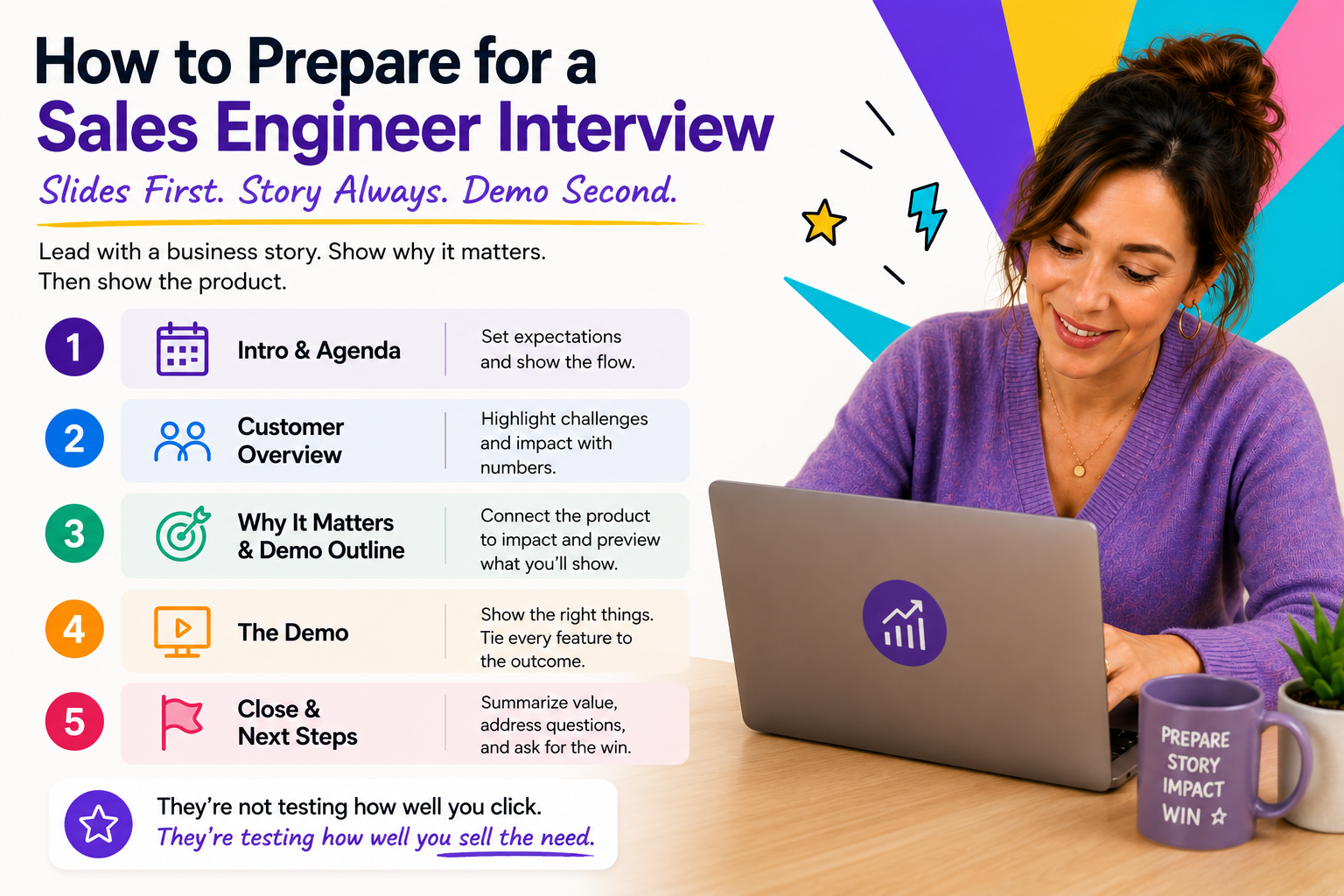
Slides first. Story always. Demo second. Panels are testing how well you sell the need—not how fast you click.
This mirrors real demo structure: context first, product second. See the demo structure hub if you want the customer-call version.
1. Intro and agenda
Lay out where you are going. Not “admin”—orientation.
Trick that gets feedback in rooms: after each section, show the agenda slide again so the panel sees what you just covered and what is next. People stay with you. Same idea as a strong demo opening: they relax when someone is driving.
Most demo mistakes are predictable. Run the checklist before your next customer call.
Generate my checklist2. Customer overview — almost more important than the demo
You are a demo storyteller. Your job is to set up the product before a single meaningful click.
Use numbers. Revenue, headcount, customer count, regions, retention—whatever fits the scenario. Pick facts that expose a gap your product closes.
- Real customer (assigned by panel): Research for an hour (Google, annual report, AI—whatever). Cite sources on the slide. If a stat is old or fuzzy, frame it as a discovery recap: “On our first call you mentioned roughly…” Panels care that you can tell the story, not that you are a forensic accountant.
- Fictional customer: Make plausible numbers. You control the story.
Then bridge one or two metrics into “why.” Example shape:
You have about $80M revenue, 12,000 customers, ~$6,700 average spend, and 70% retention. If we move retention one point, that is roughly $2M—without a single new logo.
You are not lecturing. You are showing opportunity—save money or make money. That is when the room often tips impressed before the demo. This is business storytelling in demos, not trivia.
3. What the product is, why it matters, and demo outline
Now you earn the product.
Tie your company to the gap you just quantified: “We are how you chase that retention point without bolting on three more tools.”
Do not read a feature list. Put bullets on the slide; talk only the few that match the audience (e.g. automation → smoother customer experience → retention). You are teasing the demo presentation, not dumping it early.
Then outline the demo in three beats at a high level—what you will show, in what order. One page is enough; a demo agenda template works fine.
4. The demo — and how to close it
Even if they give you 45 minutes, do not try to fill 45 minutes. Interviewers remember how they felt, not how long you talked. Finish early with a clear story beats running out the clock with extra tabs.
While you click, keep one question in your head: How does this feature help this customer?
- “When I drag this here instead of retyping, your team saves time—and your customer gets a cleaner path through the workflow.”
- “This view lets your team see behavior over time, spot high-value accounts, and target offers before churn shows up in the rollup.”
That is tell–show–tell in practice. Deeper narrative craft: how to tell a story in a demo.
End like you started: recap the sections you showed, tie each back to the business problem, then invite questions.
“So today we covered the intuitive workflow, the analytics view, and compliance controls—we believe together that supports the retention lift we talked about up front. What would you like to go deeper on?”
Optional next-steps slide—prepare it, read the room. Sometimes the panel jumps straight to Q&A.
Use clean demo transitions between beats so it feels like one story, not six mini-demos.
Tough questions (without blowing the audition)
Panels will stress-test you. Two habits matter:
Listen before you answer. Do not rush. Summarize what you heard: “So you are asking whether approvals can split by entity and threshold—is that right?” You sound seasoned and buy a few seconds to think.
You do not have to know everything—especially on their product. If you take a stab: “I would confirm in docs, but my working answer is X—I will follow up to be precise.” Calm beats bluffing. Same muscle as structuring answers in real time on live calls. If the screen breaks, recover without spiraling.
How to prep in one evening
- Pick one persona and one outcome (retention, cycle time, risk—pick one thread).
- Build slides for parts 1–3; rehearse to under seven minutes.
- Run a mock demo interview on video. Count seconds until your first click. If it is under two minutes of business context, you are on track.
- Practice one unfair interrupt and one “I do not know” answer without panic.
If you are still breaking in, pair this with how to break into presales—the loop tests performance, not pedigree.
Bottom line
Solutions Engineer interview panels are pretending to be buyers. Win the slide deck before you win the clicks. Numbers, gap, why, outline, demo, tie-back.
If you want a structured prep list for the live section, use our Demo Checklist Generator—same discipline as the job, because that is what they were hiring for all along.
Your demo isn’t converting.Get a Demo Audit.
We’ll review your live demo or product video and show you exactly what’s losing your audience — and how to fix it.
Built for real demos, not generic advice.
Pinpoint the problems
We find the exact moments where your demo loses momentum.
Get specific fixes
Clear, practical recommendations you can apply right away.
Drive more yes
A better demo experience that leads to more conversions.
Tags
Want to run better demos?
Get practical frameworks and tools used by presales teams.
Get the ChecklistContinue learning:
Related Articles
Presales Career • May 23, 2026
Sales Engineer Salary
What sales engineers earn in 2026—US, Australia, and New Zealand bands, base/OTE splits, super/KiwiSaver, AE comparison, and how to read presales vs industrial titles.
Presales Career • March 31, 2026
How to Break into Presales (From Any Background)
A practical guide on how to get into presales, understand the presales career path, and become a presales engineer without following one perfect route.
Presales Career • March 31, 2026
Your First 30 Days in Presales (What Actually Matters)
A practical guide to presales onboarding: what to focus on, what to ignore, and how to survive your first live demos in a new presales role.