

Demo Strategy
March 20, 2026
How to Handle a Bad Co-Presenter in a Software Demo
Practical ways to handle a bad co-presenter in a software demo: roles, handoffs, recovery, and prep so presales and sales stay aligned.
You have the flow mapped. Then your co-presenter jumps in with a discount joke, answers a technical question with a guess, or promises a feature you do not ship.
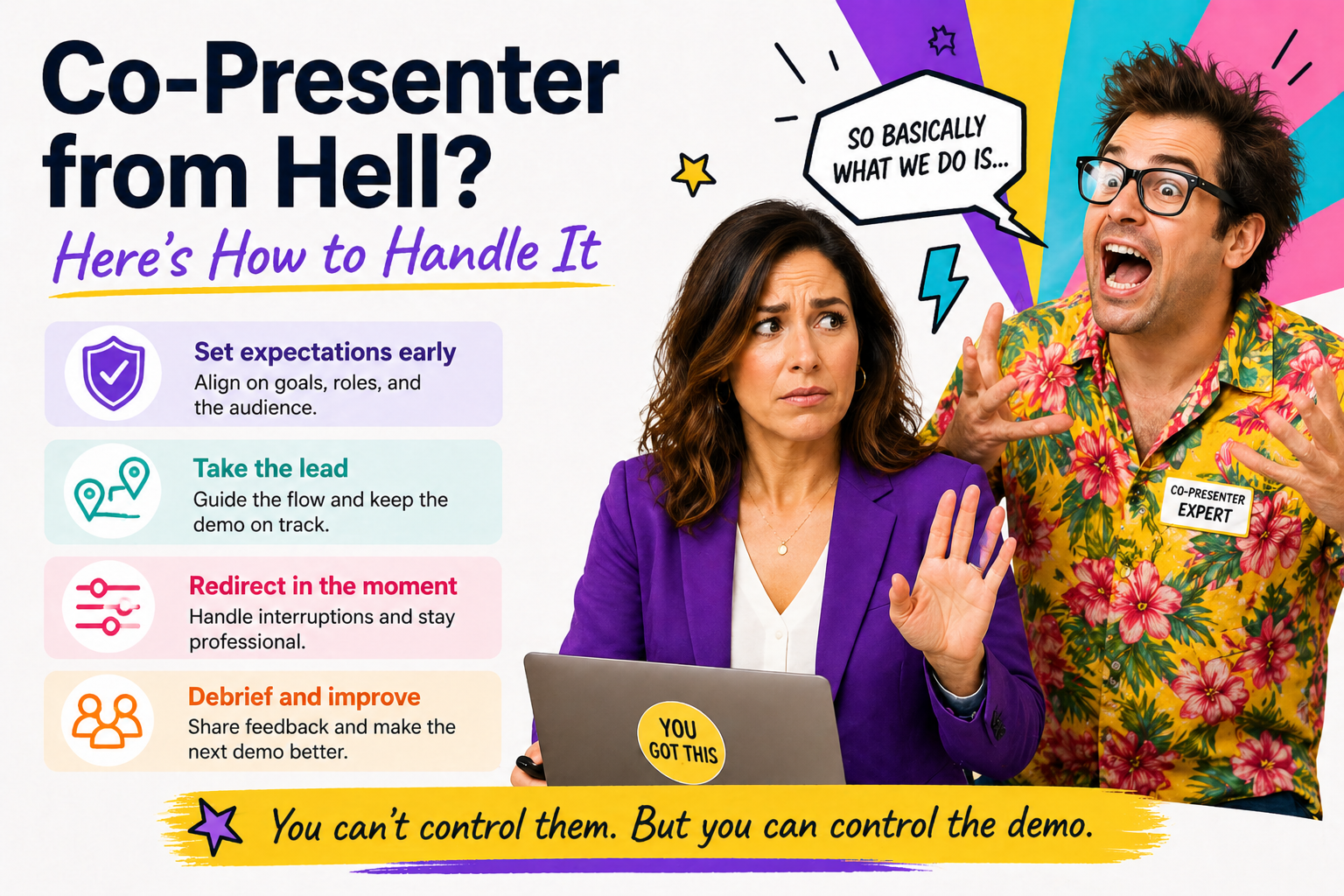
The room watches you both. The story fractures. Everyone pretends it went fine. How to handle a bad co-presenter in a software demo starts with this: the problem is rarely malice. Often they are unprepared, over-eager, or playing a different game than you. Either way, you are the one who has to fix it in the moment and before the next call.
What a bad co-presenter does in a software demo
It is the person who shares the screen or the mic and breaks the rhythm: they talk over you, contradict the story, go off-script into territory you cannot support, or turn the demo into a pitch the buyer did not ask for. The buyer stops hearing one narrative. They hear two people who are not quite aligned.
In real demos, that misalignment reads as risk. If your own team cannot stay coordinated, why should they trust you will deliver? The damage is rarely one line. It is the cumulative sense that nobody is driving.
Step-by-step: how to handle it (before, during, after)
1. Pre-brief with roles written down
Before the call, agree in writing: who opens, who owns the product walkthrough, who handles commercial questions, who takes notes. One sentence each. "I run the demo. You own intro and next steps." If you skip this, you get improvisation in front of the buyer.
2. Use a handoff phrase they cannot miss
Agree on a literal phrase: "Back to you for the workflow" or "I will hand to [name] for pricing." When someone jumps in early, you can gently reclaim: "One sec—let me finish this piece, then we will get to that." The phrase trains the room to expect one speaker at a time.
3. When they go off-script, bridge, do not argue
If they promise something wrong, do not correct them in front of the buyer in a sharp tone. Bridge: "We can confirm the exact scope in a follow-up note." Then document what was said. Fight after the call, not during.
4. Debrief within 24 hours
Most demo mistakes are predictable. Run the checklist before your next customer call.
Generate my checklistSchedule 15 minutes. What happened? What will you do differently next time? If the pattern repeats, escalate: manager, playbook, or separate calls for commercial vs technical. Ignoring it guarantees a repeat.
5. Opt out of the bad pairing when you can
If prep calls keep going sideways and they will not follow roles, you are allowed to propose a different structure: you demo alone with them on mute for intro/close, or they join only for Q&A. Not every org will agree. Many will if you frame it as buyer clarity.
6. Build a one-page "demo together" doc
Agenda, success criteria, taboo topics (pricing before value, roadmap promises, competitor trash talk), and who speaks when. Send it the day before. It is harder to ignore than a verbal "we should align."
Get better at demos
Practical ideas, teardown lessons, and tools for people who present software.
Get the ChecklistReal-world example
You are demoing an analytics product. The account executive opens strong, then interrupts mid-workflow to pitch a bundle the buyer did not ask for. The buyer goes quiet. You pause the screen share. "Let me finish this view so you see how alerts work—then we can absolutely talk packaging." You complete the flow. After the call, you message the AE: "When we jumped to bundle before they saw value, we lost them. Next time can we stick to the doc—workflow first, commercial after?" You attach the one-pager. Next demo, they stay in lane.
Common mistakes to avoid
- Assuming "we have done this before" counts as a prep
- Correcting your co-presenter harshly on the call
- Letting them own answers they are guessing on
- Skipping the debrief because the deal "still might close"
- Enabling the same pairing when the pattern never improves
- Forgetting to document misaligned promises for your own protection
Pro tips (the secret sauce)
Mute is your friend. On video, whoever is not speaking can stay muted. It cuts accidental talk-over and signals one voice at a time.
The buyer should hear one story. If two people must speak, they should sound like one team with one plan. That only happens with prep.
Save face in public, be direct in private. Preserving the relationship matters if you will share dozens more calls. The fix is after the curtain.
Escalate early if it is a pattern. One bad day is human. Six demos in a row is a process problem.
Offer to run the dry run. If they will not prep with you, offer 20 minutes. Often resistance is time, not intent.
Learn more and apply this
Co-presenting is a skill, not a default. For recovery when the call goes sideways, read How to Recover from Demo Mistakes. For staying grounded when delivery wobbles, see How to Be Confident in Demos.
If you want a structured way to apply this, use our Demo Checklist Generator.
Your demo isn’t converting.Get a Demo Audit.
We’ll review your live demo or product video and show you exactly what’s losing your audience — and how to fix it.
Built for real demos, not generic advice.
Pinpoint the problems
We find the exact moments where your demo loses momentum.
Get specific fixes
Clear, practical recommendations you can apply right away.
Drive more yes
A better demo experience that leads to more conversions.
Tags
Want to run better demos?
Get practical frameworks and tools used by presales teams.
Get the ChecklistContinue learning:
Related Articles
Demo Strategy • March 20, 2026
Demo Delivery Techniques
The mechanics of how you present: voice, pacing, screen hygiene, and handling interruptions so your demo lands.
Demo Strategy • March 20, 2026
How to Be Confident in Demos
Real confidence in demos doesn’t come from personality. It comes from exposure, recovery, and knowing what to do when things go wrong.
Demo Strategy • March 20, 2026
How to Engage Audience in Demo
Practical tactics for sales engineers and presales teams who want to hold attention and drive outcomes during software demos.